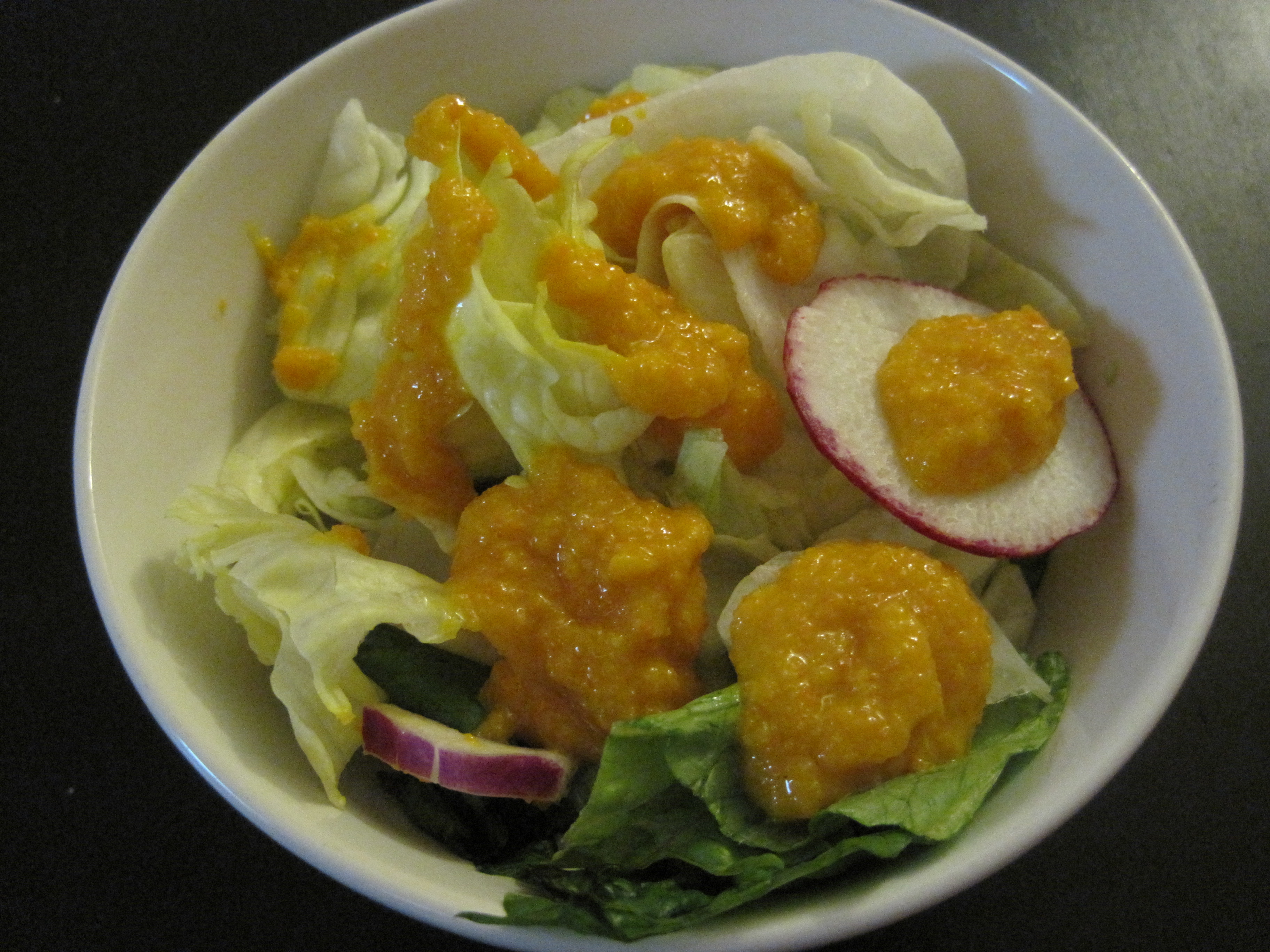
I had a lot of miso paste leftover from making miso soup (recipe here), so I made a miso salad dressing for a Japanese restaurant style salad. Note that you could omit the carrot and use the rest of the ingredients (adjusted to your taste) to make a simpler miso salad dressing. I served this with miso soup and chicken teriyaki with a stir fried bean sprout medley (recipe here).
Posts Tagged ‘recipes’
Apple Cranberry Cake Served with Hot Cream Sauce
In Cakes, Sides and Sauces on February 25, 2011 at am
After a successful [first time] use of fresh cranberries in a cranberry sauce, I became obsessed with them. I baked cranberry bran muffins, two cranberry almond cakes, and a cranberry walnut tart. By the time the grocery stores stopped carrying fresh cranberries, I only had 1 cup left. I was hesitant to use my last cranberries on just any recipe, so I was very excited when I discovered this German apple cranberry cake from Thomas Keller’s The French Laundry Cookbook. The cake is simple, moist, and nicely dense. Although the cake is good on its own, I just love the comfort and indulgence of the warm sauce.
A Simple Way to Cool and Remove a Baked Tart From the Pan
In How-To, Pies & Tarts on February 22, 2011 at amI learned this great tip from Martha Stewart’s Everyday Food magazine. Unfortunately, it only works on tart pans with a removable bottom. This single [simple] move will allow you to: 1. easily and safely remove a hot, baked tart from its pan; 2. cool your tart faster; and 3. prevent the crust from being over baked. Simply turn a flat bottomed, heatproof bowl upside down and set the tart pan on the bottom (now pointing upwards) of that bowl. See the photo below of my cranberry walnut tart cooling.
How To For Durian (Fruit)
In How-To on February 19, 2011 at amDurian fruit is definitely an acquired taste – one which can only be acquired if you can get over the acquired smell. They are heavy and covered with pointy, dangerous spikes. As you can see from the photos below, the fruit is shaped into several lobes. Each lobe contains soft, yellow flesh that encases one or two large, light brown, hard seeds. You can eat it as is (not the seed), or you can use it in smoothies and cakes, etc. In North America, you are most likely to find these frozen. Simply defrost the durian at room temperature and cut open. Opening a durian almost always involves injury, so be very careful. I get scratched (and bleed) several times simply transporting it from the grocery store to the house. I have provided tips on how to select a durian and photo instructions for how to open one. Notice that it’s my dad doing it. Thanks dad 🙂
Steamed Minced Pork (3 Variations)
In Meat and Eggs on February 16, 2011 at amIn many Chinese homes, this quick and simple dish is served with rice and other dishes for dinner. I have provided recipes for 3 different variations, but you could use any ingredients and any combination that you like. My favourite combination is the steamed minced pork with salty duck eggs. (I will load a photo the next time I make it.)
Steamed minced pork with muy choi (Chinese salted mustard) is shown below. Note that traditionally, the meat is seasoned with soy sauce and the muy choi is simply scattered over the top. However, I’ve reduced the sodium of this dish by omitting the soy sauce and mixing the muy choi (which is already salty) in with the meat.
Aioli (Garlic Mayonnaise) Recipe
In Sides and Sauces on February 11, 2011 at amJulia Child’s aioli recipe from Mastering the Art of French Cooking calls for white bread and a mortar and pestle. One day, I will try making aioli the traditional (proper) way (post to follow), but for now, I’m happy using my food processor to make a garlic flavoured mayonnaise. You can serve aioli as a dip (perfect for deep fried sweet potato fries) or use it in any way that you would use mayonnaise.
Deep Fried Calamari Recipe
In Appetizers, Hors D'oeuvres, Snacks on February 10, 2011 at amEvery restaurant uses a different coating or batter for deep fried calamari. Personally, I prefer calamari that is crispy, but very lightly coated so that you can enjoy the subtle taste of the squid. I’ve made this several times now and it always works – as long as you watch the temperature of the oil carefully (see the note below for details).
Photo above: Half of what the recipe makes is shown above.
(Keep your eyes open for my recipe for deep fried squid tentacles, Chinese salt and pepper style.)
Chinese Bakery Hot Dog Buns Recipe
In Baked Bread on February 8, 2011 at amChinese bakeries always have a great variety of buns, cakes, and cookies to choose from. I love Hong Kong style bakery buns because the brioche-like bread is super soft. One of my favourites is the hot dog bun and luckily, it’s very easy to make. Although it is time consuming to make the dough, most of the time is spent waiting for it to rise. I tried three different recipes for Chinese / Japanese style bread and the water roux method (tang zhong) was by far the best. My family couldn’t get enough of these. 🙂 These are freezer friendly so you can make your efforts last.
Depending on the bakery, I’ve seen hot dog buns shaped in one of two ways (photos below). Instructions for both have been provided.
Asian Bread Making Technique (Soft Chinese / Japanese Bread)
In Baked Bread, Breads on February 7, 2011 at amJapanese and Chinese breads are well known and loved because they are deliciously soft and fluffy. When Yvonne Chen published The 65 C Bread Doctor, she made the water roux method (tang zhong) very popular. I tried two other highly rated asian bread recipes before attempting this and the water roux method (tang zhong) was, by far, the best. My family absolutely loved it. This results in bread very similar to those sold in Hong Kong (Cantonese/Chinese) bakeries. By changing the way you shape the bread and by adding various ingredients, you can use this as your base for all sorts of buns and breads. For example, see my instructions for Chinese bakery hot dog buns here. Coming soon: recipes for Chinese bakery pineapple buns and cocktail buns.
How to Make Bread Flour and Cake Flour Substitutions
In How-To on February 5, 2011 at am
I have containers upon containers (upon containers) of different dry ingredients overcrowding my pantry, cupboards, and counter top. I’m embarrassed to admit that they’ve overflowed into closets and random corners of the rest of my apartment too. Just to name the different types of flour that I have: all purpose, bread, cake, whole wheat, stone ground whole wheat, organic whole wheat, semolina, rice, glutinous rice, potato, tapioca, corn (as well as corn meal), corn starch, wheat starch, and vital wheat gluten. I actually have a post card that says “I dream of storage space” on my fridge (photo above). 🙂 So when I discovered simple substitutions for bread flour and cake flour, I was overly excited! haha I love decluttering and now I’ll never have to buy cake or bread flour again. Recipes below.
Chinese New Year Steamed Cake (nian gao)
In Asian Desserts on February 3, 2011 at amNian gao is a steamed cake that is traditionally eaten at Chinese New Year. During the 2 week long celebration, nian gao is often given and received as gifts. It is a vegan cake made with glutinous rice flour (also known as sticky rice flour). Since it does not contain eggs or baking powder/soda, it has a chewy, dense, and slightly sticky texture. It really only tastes good when served hot, either from the steamer or pan fried (see photo below). Also, note that nian gao is not meant to be very sweet (but you can use more sugar if you’d like). There are variations of nian gao that you could try (ie. using coconut milk) and there are very good baked nian gao cakes too (see my recipe here). The recipe below is for the plain, traditional steamed cake.
(Another steamed cake that is often enjoyed at Chinese New Year is turnip cake. See my improved recipe here.)
Photo below: Slices of the nian gao are coated in raw egg and pan fried in a little bit of oil. But some people prefer to omit the egg and pan fry the nian gao directly in the oil.